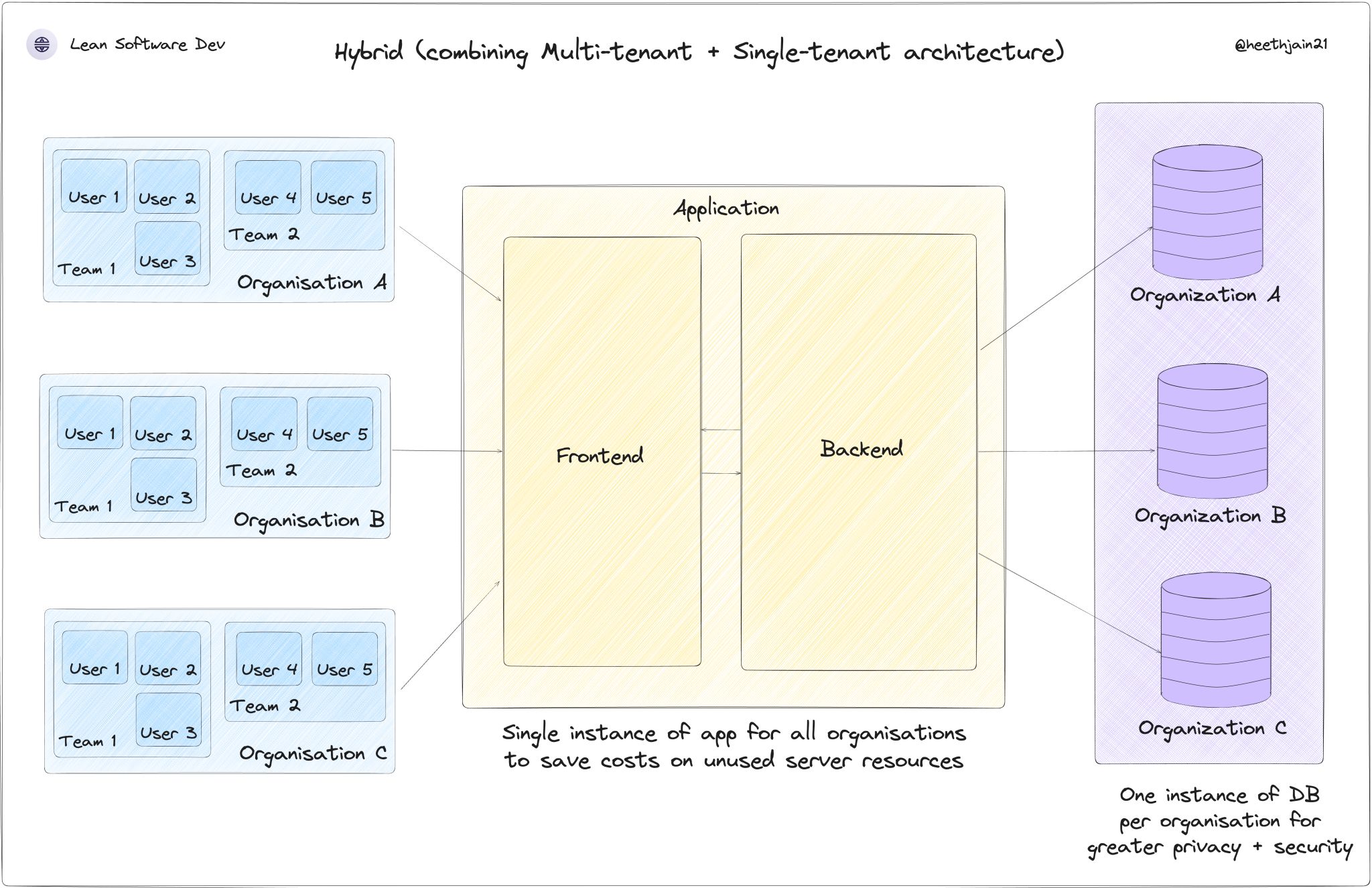
Hybrid Tenant Architecture
Balancing isolation and cost for multi-organization SaaS
Problem
The client was building a B2B marketplace where transport companies stored sensitive operational data. With a shared database, one bad query or access control bug could leak Company A's data to Company B, a massive problem for enterprise customers. But spinning up fully isolated infrastructure per tenant would burn through their runway at the current stage.
Constraints
- Full app-and-db isolation per tenant would multiply infra and operational overhead.
- Shared everything storage increased blast radius and customer trust concerns.
- We needed a model that supported tenant growth without creating per tenant deployment workflows.
- The team needed operational simplicity over maximal architectural purity at this stage.
Solution
- Implemented a hybrid tenancy architecture.
- Kept a shared app tier for routing, auth, and business logic.
- Provisioned a separate Turso database per tenant for stronger data boundaries.
- Chose this middle ground over full single tenant stacks to keep cost and operations manageable while still improving isolation materially.
Outcome
- Improved tenant isolation significantly without adding per tenant app servers.
- Reduced cross tenant data risk compared to shared database approaches.
- Preserved a deployment model small teams can actually maintain week to week.
- Established an architecture that can evolve toward stricter isolation later without a full rebuild now.
Stack
- Node.js (Fastify)
- Turso (LibSQL / SQLite)
- Fly (infrastructure)